ABOUT US
The Dharma Foundation was borne out of a deep sense of the need for those of us, who are able to, to follow and uphold the principles of Dharma, in its purest form. While we recognise that we do not have endless resources to heal the world, we have chosen areas in which we have insights, enabling us to have a higher likelihood of fulfilling the goal of service to others, for no other reason but that it is the right thing to do.
The word Dharma comes from a Sanskrit word root that means “to uphold, support, bear.”
Definitions and Meanings of Dharma:
The meaning of Dharma cannot be directly translated into a single word or several words, since it is a complex concept, several thousands of years old. Some facets of Dharma are captured below.
The “path of righteousness,” including a fundamental belief in the equality of all people and the duty to share and offer service to others
Moral order of the universe and a code of living that embodies the fundamental principles of law, religion, and duty that governs all reality
Moral law governing individual conduct and is one of the four ends of life
Universal truth common to all individuals at all times
The order which supports the whole world, from the laws of nature to the inner workings of conscience
Dharma is simultaneously the eternal order that rules the universe and the duty or law that governs one’s life.
Fulfilling one’s dharma is more than simply one’s purpose in life – it is considered the very means by which one transcends suffering and the cycle of birth and death
Includes precepts that align with the highest ethos of causing no harm to any living thing, large or small
Natural universal laws whose observance enables humans to be contented and happy and to save himself from degradation and suffering. Dharma is the moral law combined with spiritual discipline that guides one’s life
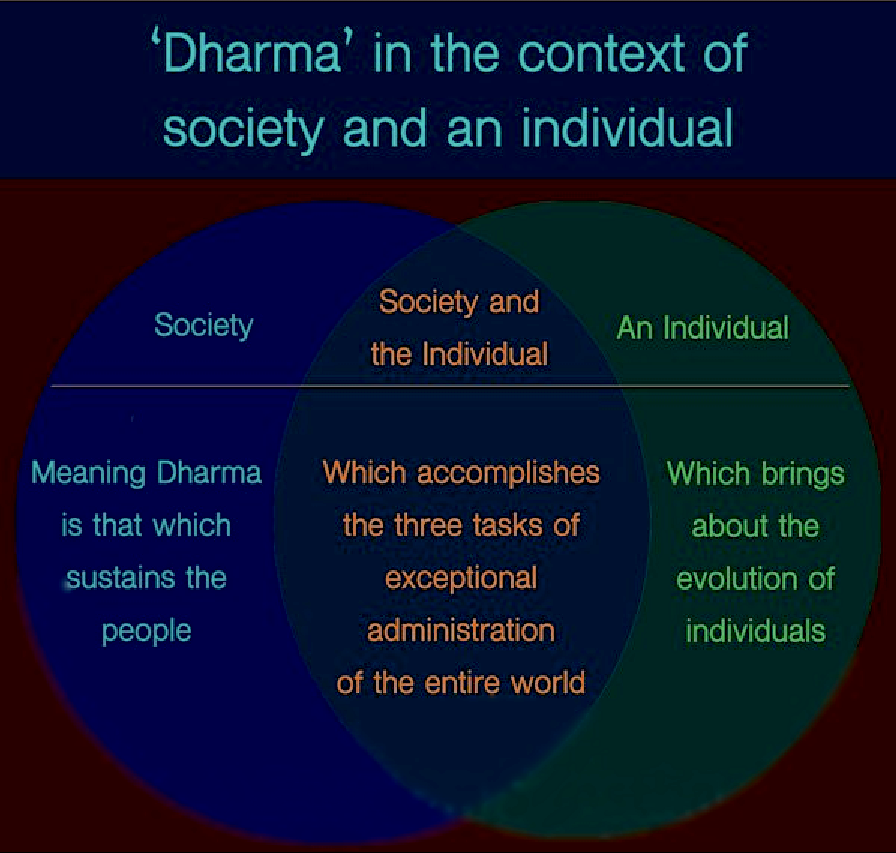
It means “that which holds” the people of this world and the whole creation.
Dharma is the “law of being” without which things cannot exist
The 10 Rules of Dharma
Written by the ancient sage Manu
- Patience (dhriti)
- Forgiveness (kshama)
- Piety, or self control (dama)
- Honesty (asteya)
- Sanctity (shauch)
- Control of senses (indraiya-nigrah)
- Reason (dhi)
- Knowledge or learning (vidya)
- Truthfulness (satya)
- Absence of anger (krodha)